Let’s see what makes the newest drivers on the market shine!

There is something exciting about standing on the tee box with a driver in your hands. It is the club that starts the hole, sets the tone for the round, and-let’s be honest-is often the most fun to swing.
It is also the club that changes the fastest in golf technology. Every year, manufacturers experiment with new materials, smarter engineering, and more adjustable designs to help golfers hit the ball farther and more consistently. While no club can magically fix a swing overnight, modern drivers are designed to be more forgiving than ever before. That means better ball speed on mishits, higher launch, and more stability across the face.
For many golfers, upgrading to a newer driver can make a noticeable difference-especially if their current club is several years old. Advances in lightweight materials and weight distribution can help players generate more clubhead speed and keep shots straighter, even when contact isn’t perfect.
Fitting Comes First:
Before we begin, it is worth remembering that the best driver is not always the newest one. The best driver is the one that fits you. This is where professional club fitting can make a big difference. A trained fitter can look at details such as your swing speed, launch angle, and strike pattern to help match you with the right clubhead, loft, and shaft combination.
Of course, it is hard not to get excited about the latest technology, especially when you compare it to a driver that may have been sitting in the garage since the early 2000s. New drivers are designed with smarter materials and more forgiving faces, which can make the game feel a little easier and a lot more fun. Still, the key is testing a few options and finding the setup that works best for your swing and your body.
With that in mind, here is a look at some of the newest drivers making waves in 2026 from PXG, Callaway, Titleist, PING, and XXIO and why golfers are so excited to tee them up.
PXG Lightning Drivers
A lineup designed to match different types of golfers
PXG’s newest driver release is called the Lightning family, and the name alone gives you a hint at what the company is aiming for: speed.
When brands release a “family” of drivers, it means they create multiple versions built around the same technology platform but tailored for different playing styles. Some golfers want maximum forgiveness, others want more control, and some simply want a driver that feels lighter and easier to swing.
PXG’s Lightning drivers focus heavily on face technology and carbon construction. By using more carbon fiber in the clubhead, engineers are able to reposition weight to make the driver more stable at impact. The result is a club designed to maintain speed even when the ball isn’t struck perfectly in the center.
Another highlight is PXG’s Frequency Tuned Face, which is designed to help the clubface flex more efficiently during impact. In simple terms, this means more energy is transferred to the golf ball, which can help produce faster ball speeds.
The Lightning lineup includes several models, each designed with a slightly different golfer in mind-from players who want maximum forgiveness to those who prefer a more compact, tour-inspired shape.
What stands out most about the Lightning series is how adjustable it is. Weighting ports allow golfers or fitters to fine-tune the club’s balance, helping encourage a straighter ball flight or even reduce a slice. It’s a reminder that modern drivers are not just about distance-they’re about customization.
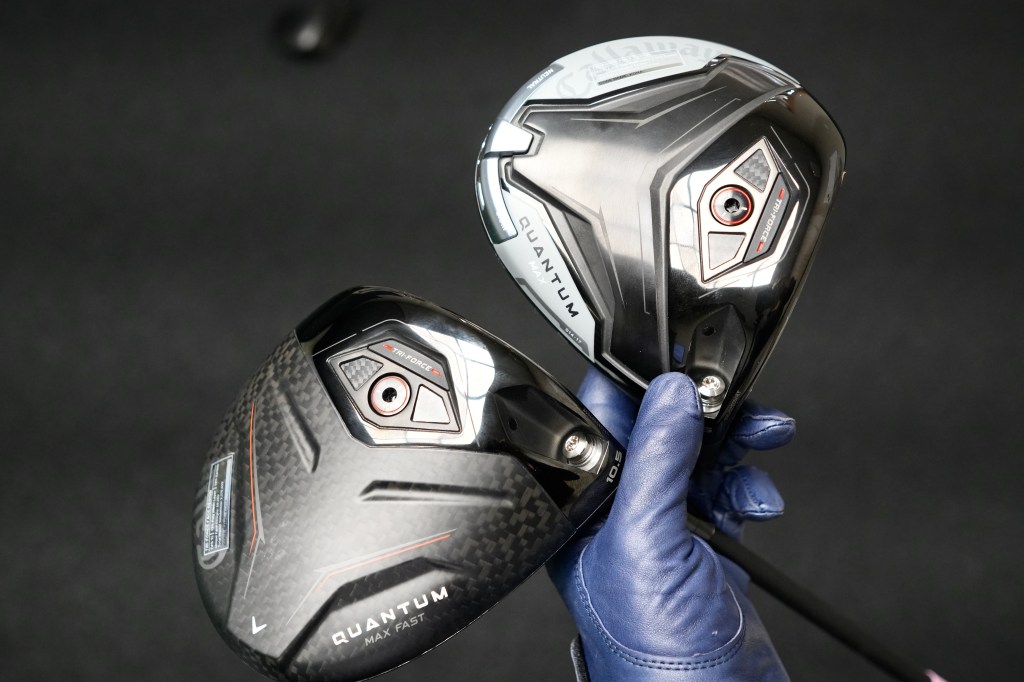
Callaway Quantum Drivers
Where artificial intelligence meets golf club design
Callaway has been a leader in golf innovation for years, and their newest driver family, Quantum, continues that tradition.
One of the most fascinating elements of the Quantum drivers is how they were designed. Callaway engineers used artificial intelligence simulations to analyze thousands of impact patterns across the clubface. This data helped them create a face design that maintains ball speed across a larger area.
In other words, if your strike drifts slightly toward the toe or heel-a common occurrence for many golfers-you’re more likely to maintain distance.
The Quantum drivers also introduce what Callaway calls a Tri-Force Face, which blends multiple materials together to create a balance of strength and flexibility. This layered design helps the clubface respond efficiently at impact.
But technology aside, Callaway’s real focus with the Quantum lineup is versatility. The family includes different models that emphasize forgiveness, workability, and draw bias. This gives golfers a chance to find the driver that matches their swing tendencies rather than forcing their swing to match the club.
For many recreational players, that flexibility can be the difference between fighting the driver and feeling confident when stepping onto the tee.
Titleist GT Drivers
A blend of classic looks and modern performance
Titleist has long been known for its clean, classic-looking drivers, and the GT driver series carries that reputation forward while quietly packing in some impressive technology.
The GT drivers focus on three core goals: speed, stability, and consistency. One of the key design elements is a lightweight crown made from a specialized polymer material. By making the top of the club lighter, engineers can move weight elsewhere in the head to improve forgiveness and launch.
Another feature that stands out is the driver’s adjustable system, which allows golfers and fitters to fine-tune the loft and lie angle. These adjustments might seem small, but even a slight change can influence ball flight and shot shape.
Titleist drivers have always had a loyal following among golfers who appreciate simplicity and performance without flashy design. The GT lineup continues that philosophy, offering a driver that looks traditional but performs at the cutting edge of modern engineering.
And for those who love staying ahead of the curve, Titleist has hinted that a new generation of drivers is expected later in 2026, meaning the brand’s innovation is far from slowing down.
PING G440 Drivers
Built with forgiveness as the top priority
If there is one word that consistently comes up when golfers talk about PING drivers, it is forgiveness.
PING’s newest driver release, the G440 series, continues that legacy. The company designed these drivers to help keep shots straighter, even when the strike isn’t perfect.
One of the ways PING accomplishes this is by increasing something called moment of inertia, or MOI. Without getting too technical, MOI measures how resistant the clubhead is to twisting when the ball is struck away from the center. Higher MOI generally means more stability and straighter shots.
The G440 drivers also incorporate carbon fiber sections in the clubhead. These lightweight areas allow engineers to reposition weight lower and farther back, which helps the ball launch higher and increases forgiveness.
For golfers who value accuracy over everything else-and for anyone who has ever watched a drive drift into the rough-this kind of stability can be incredibly appealing.

XXIO 14 Drivers
Lightweight design made for effortless distance
XXIO (pronounced “zek-see-oh”) approaches driver design a little differently than most brands. Instead of creating clubs for every possible swing speed, the company focuses specifically on golfers with moderate swing speeds.
This category includes many recreational golfers and a large portion of women players.
The XXIO 14 driver is built around the idea that distance should feel effortless. Rather than asking golfers to swing harder, the club is engineered to help generate speed more naturally through lightweight construction.
One of its standout features is ActivWing, a small aerodynamic structure on the top of the clubhead. This feature helps stabilize the club during the downswing and guide the face into a more square position at impact.
The result is a driver that aims to make the swing feel smoother and more controlled, while still delivering solid distance.
For golfers who prefer a lighter club that feels easy to swing throughout an entire round, XXIO has developed a strong reputation.
Why Getting Fit for a Driver Matters
With so many impressive drivers on the market, it can be tempting to simply choose the newest model or the one your favorite professional golfer uses. But the reality is that driver performance depends heavily on fit.
A professional club fitter can evaluate your swing and determine the best combination of loft, shaft weight, shaft flex, and clubhead design. Even small adjustments can make a big difference in launch angle, spin rate, and shot dispersion.
Many golfers are surprised to learn that the right driver setup can add distance without changing their swing at all. A properly fitted driver simply helps the swing you already have perform more efficiently.
Think of it this way: modern drivers are incredibly advanced pieces of technology, but they work best when they are matched to the golfer using them.

The “Drive” Home
The newest drivers from PXG, Callaway, Titleist, PING, XXIO, and so many new drivers on the market show just how much golf technology continues to evolve. Lighter materials, smarter face designs, and more adjustability are helping golfers hit the ball farther and straighter than ever before.
But perhaps the most exciting part of modern equipment is how customizable it has become. Whether you prioritize forgiveness, feel, distance, or consistency, there is likely a driver designed to complement your game.

 MS. SWAG GOLF